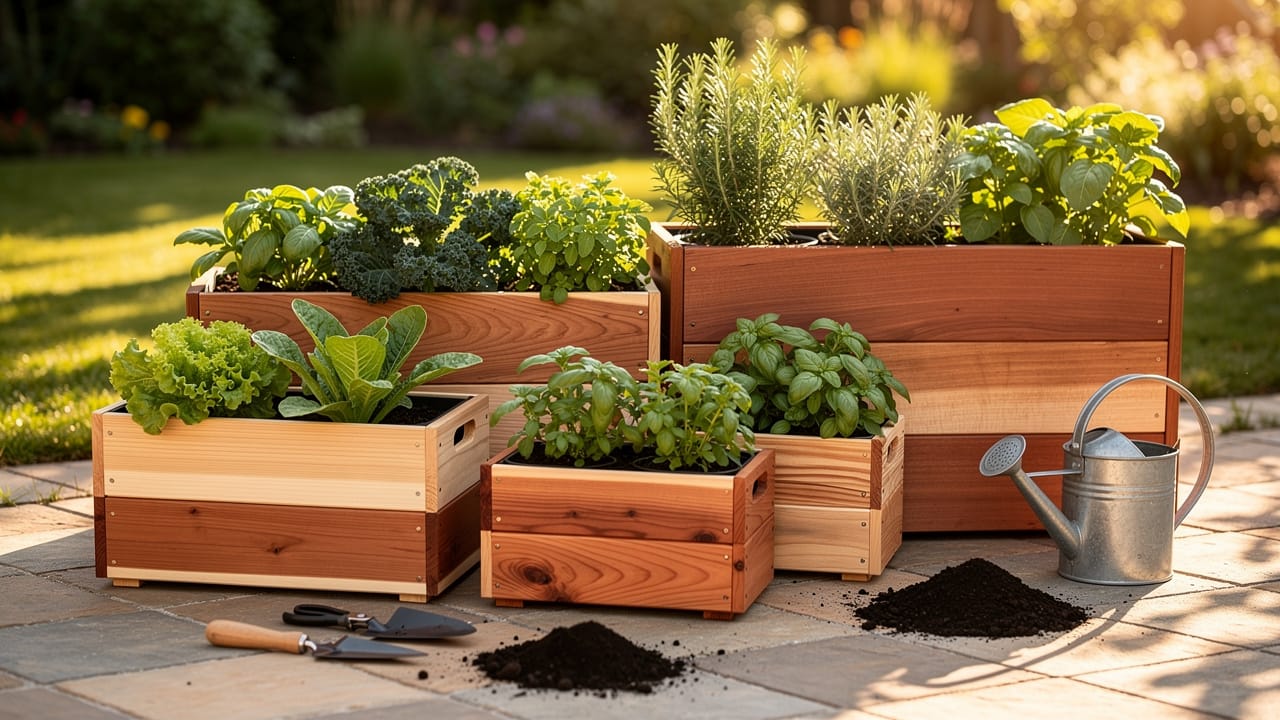
If you’re building or buying a planter box, the wood you choose will determine whether your planter lasts three years or thirty. Not all lumber handles constant moisture and soil contact equally well. Some species rot within a single season, while others stand strong for decades without chemical treatment.
This guide cuts through the confusion. We’ll compare the most common woods for planter box —cedar, redwood, pressure-treated pine, cypress, and others—based on rot resistance, safety for edibles, cost, and real-world durability. You’ll learn which options deliver the best value and which to avoid, so you can buy a planter box that lasts.
Key Takeaways
- Wood choice decides how long a planter box lasts. Premium options like cedar, redwood, and cypress give 10–20 years of service, while untreated pine often fails in just a few seasons when it stays in contact with wet soil.
- The best wood for planter box projects is not the same for every region or price point. Cedar and redwood shine in premium lines, cypress fits humid Southern markets, and pressure-treated pine works well when buyers need a long-lasting but lower-cost raised garden bed option.
- Modern pressure-treated lumber that uses copper-based preservatives is considered safe for food gardens, and a major Oregon State University study found no extra copper in vegetables grown in those beds.
- Board thickness, liners, drainage, and plant-safe finishes matter almost as much as species. Thick 2‑inch boards, good drainage holes, interior barriers, and sustainable finishes all help a durable wooden planter hold up well and protect plant health.
Why Wood Selection Makes or Breaks Your Planter Box Investment

When we design a fence, we worry about rain and sun. When we design a planter box, we add one more constant enemy: wet, heavy soil pressing on the boards every single day. That mix of moisture, oxygen, and soil microbes speeds up decay, while the weight of a full raised garden bed pushes the walls outward.
Because of this, planter boxes fail faster than decks or fences if the material is wrong. Natural oils and tannins in some woods slow down rot and insect damage. Other woods have very little natural protection. If those weaker species sit in damp soil, they can start to soften and crack in just a few years.
When we talk with wholesale buyers, we always return to six decision points:
- Rot resistance – sets the basic durability and lifespan of the planter.
- Structural integrity – depends heavily on board thickness and design; thin fence boards bow under soil pressure.
- Chemical safety – matters for food gardens where wood can contact edible plants and soil.
- Cost-effectiveness – looks at total cost of ownership, not just the first invoice.
- Regional availability – affects price, lead times, and supply stability.
- Sustainability – including certified timber and replanting programs, shapes how well a product fits modern consumer values.
Board thickness deserves special attention. Wet soil is heavy, and a deep raised garden bed can push hard on side walls. Thin 5/8‑inch or 3/4‑inch planks tend to warp, crack, and pull away at the corners. By contrast, 2‑inch nominal (1.5‑inch actual) boards hold their shape and resist that outward force for ten years or more with the right wood species.
Premium Naturally Rot-Resistant Woods – The Gold Standards

When buyers ask us what the best wood for planter box upgrades is, we start with the naturally rot-resistant species. These woods stand up to moisture without chemical treatment because their heartwood carries natural oils and tannins that resist fungi and insects. They work well for food gardens, ornamental plants, and high-traffic commercial spaces.
Cedar
Cedar is a good choice for premium planter boxes. The heartwood is rich in natural oils and tannins that act like a built‑in preservative. These compounds slow rot, resist wood‑boring pests, and let cedar sit next to moist soil for many years without chemical treatment.
In real use, a well-built cedar raised garden planter often lasts 10–15 years, and sometimes longer. That is a huge gain compared with soft pine boards that may need replacement after three or four growing seasons.
Fresh cedar ranges from light tan to warm reddish tones, and over time it weathers to a soft silver‑gray that many gardeners love. That natural color shift helps cedar planter boxes look at home in both rustic and modern outdoor spaces.
Redwood
Redwood sits beside cedar as a top answer when someone asks which wood is best for high-end planter boxes. Its heartwood holds strong natural tannins that make it very rot resistant and unattractive to many insects. Under normal outdoor use, a redwood planter commonly lasts 10–20 years, especially when built with thicker boards and good drainage.
Redwood is especially common along the West Coast, where local supply often makes it a natural choice for premium lines. It has a rich red‑brown color and straight grain that look striking in retail displays, restaurant patios, and high‑end residential yards.
Cypress
Cypress offers a powerful alternative in the Southern and Eastern US. The heartwood contains an oil called cypressene that gives strong resistance to decay and pests. Cypress holds up very well in humid, rainy climates where lesser woods struggle. Because it is often milled closer to those markets, cypress can be more affordable than cedar or redwood in that region while still giving a long lifespan.
Budget-Friendly Options
Not every customer wants or needs a premium cedar or redwood planter. For price-sensitive markets or short‑term setups, softer woods like pine, fir, and hemlock are common. These are true softwood species with lower tannin content and very limited rot resistance. When they sit in constant soil contact as an outdoor planter box, they usually last about 2–4 years if left untreated.
Douglas‑fir lands in a middle spot. It is stronger than basic pine and has slightly better resistance, yet it still cannot match cedar or redwood in wet conditions. To get more life from these budget woods, we strongly suggest:
- An interior plastic liner
- A food‑safe sealer on interior faces
- Solid drainage design with generous holes
Pressure-Treated Wood Explained – Separating Myth from Science

Pressure-treated lumber can cause concern when people think about vegetables, herbs, and edible flowers. Older treated wood really did carry chemicals no one wants near a salad bed. Modern pressure-treated boards are different, and for many wholesale buyers they offer a practical way to deliver long-lasting raised beds at lower cost.
The Evolution from CCA to Modern Copper-Based Treatments
For many years, treated timber used a preservative called Chromated Copper Arsenate, or CCA. This mix included arsenic, and over time testing raised clear health concerns. In 2003, the US Environmental Protection Agency banned CCA for almost all residential uses, including garden beds, decks, and playsets. That old material should never be used for a planter box.
Modern treated lumber uses different formulas. The common ones are ACQ (Alkaline Copper Quaternary), CA‑C (Copper Azole), and MCA (Micronized Copper Azole). In these treatments, copper acts as the main fungicide and insect barrier. The EPA classifies them as low‑risk for residential use, including garden structures.
What Research Actually Shows – The Oregon State University Study
To test modern treated wood in real raised garden bed conditions, researchers at Oregon State University ran a multi‑year study. They built side‑by‑side beds from untreated Douglas‑fir and from Douglas‑fir treated with CA‑C for ground contact. All beds used the same soil, the same crops, and the same watering patterns.
Over several seasons, the team measured copper levels in the soil and in the harvested vegetables and herbs. They did find a small increase in copper in a narrow band of soil right next to the treated boards, about one inch from the wood. Even there, the copper levels stayed within the natural range for that region’s soils.
The key result matters most for wholesalers who sell to food gardeners. Test after test showed no extra copper inside the plants grown in treated beds compared with plants from untreated beds. Root crops and leafy greens came out the same. In simple terms, the wood released a little copper at the surface, but it did not move into the edible parts of the crops.
This research gives a solid base for buyers who want a longer‑lasting, rot-resistant option on a budget. When modern copper-treated lumber carries a ground‑contact rating and is used correctly, it can serve as a safe, long‑life frame for a raised garden bed.
Best Practices for Treated Wood Planter Boxes
Even with good science behind pressure-treated lumber, we follow a few habits to keep both plants and customers comfortable. New treated boards often arrive wet from the treatment tank, so we like to let them dry for at least a few months before building boxs. This step lets excess moisture evaporate and reduces early surface leaching.
When we design treated‑wood planters, we often:
- Line the interior sides with heavy food‑grade plastic or pond liner.
- Punch drainage holes so water still exits freely.
- Specify hot‑dipped galvanized or stainless‑steel screws, since copper preservatives can corrode regular steel fasteners.
- Suggest that gardeners plant edible crops a few inches away from the inner walls.
Critical Quality Factors – Lumber Selection and Evaluation

Wood species sets the starting point for performance, yet it is not the whole story. The way boards are cut, their thickness, and their quality at arrival all shape how long a planter box will last. Even the best wood for planter box designs will fail early if someone builds them from thin, crooked, or badly damaged boards.
As a manufacturer, we apply the same checks that we suggest to our partners. These checks are simple to understand, but they make a big difference for the lifespan of a durable wooden planter in real outdoor use.
Board Thickness – The Most Critical Structural Decision
If we had to pick one structural choice that matters most, it would be board thickness. For planter box walls, we treat 2‑inch nominal lumber (which finishes at about 1.5 inches thick) as the standard. At this size, the wood can handle the outward push of wet, packed soil season after season without bowing.
We keep thinner stock for trim and decorative caps where there is no soil load. That way, wholesale buyers get a planter that feels solid in the hand and keeps its shape on the patio, while still offering graceful finishing touches on the top edge.
Lumber Inspection and Quality Control Checklist
Quality starts at the lumber pile. Before we cut a single board for a planter box, we move through a simple but strict checklist:
- Straightness:
We look down the length of the board and stack pieces together to spot any twist or bow. Straight boards build square, tight boxes that resist soil pressure much better than frames made from warped pieces. - Defects:
We scan for large loose knots, deep cracks, and splits at the ends that could create weak spots under load. Surface damage such as chips, big scratches, or discoloration can also affect retail appearance. - Moisture and storage:
We check that boards were stored off the ground and under cover. Poor storage can introduce staining, warping, or mold that shortens the usable life of the wood. - Actual dimensions:
A board sold as 2 x 6 x 8 usually measures about 1.5 inches by 5.5 inches by 8 feet once milled. Knowing the real size helps us plan box height, soil volume, and shipping weights.
Strategic Sourcing by Region and Sustainability
The best wood for planter box lines often depends on where those boxes will be sold. In the Western US, redwood and Douglas‑fir are easy to find and can keep costs down. In the Midwest, cedar is usually the most practical premium choice. In the South and East, cypress gives strong rot resistance at a fair price, and in Canada, hemlock often fills the budget role.
Transport distance affects both cost and carbon impact, so local or regional species often win on total value. For global orders, other woods such as teak in Southeast Asia, mahogany in parts of Africa, or ironwood in Central and South America may also make sense.
We look for mills that follow replanting programs and hold FSC or PEFC certification. QlycheeCrafts builds its supply chain around these standards so partners can sell planter boxes that fit both business goals and sustainability promises.
Maximizing Lifespan – Construction Techniques and Protective Treatments

Once we choose the right wood for planter boxes, construction details and protective steps decide how long that wood keeps working. Two planters made from the same cedar can age very differently if one has poor drainage and bare, soil‑exposed interiors, while the other has smart design and gentle protection.
Protective Liners and Interior Barriers
Interior liners are one of the simplest ways to stretch the lifespan of any wooden planter box. We commonly use 4–6 mil heavy‑duty plastic sheeting or flexible pond liner along the interior walls. The liner sits against the sides, while we punch plenty of drainage holes where the liner meets the bottom so water can still flow out freely.
By keeping wet soil off the wood, liners slow down rot in budget woods like pine and fir. In real use, this can almost double their service life. Even in premium cedar or redwood beds, a liner can add several extra years before any decay shows near the interior face. For treated lumber, an interior barrier also eases customer concerns about chemicals that might leach into the soil.
Safe Wood Treatments, Stains, and Finishes
Next to liners, plant‑safe finishes give another layer of defense. On the exterior, we like eco‑friendly stains and clear coats with UV resistance and low VOC levels. These finishes slow fading, reduce surface cracking, and protect against rain and sun without adding strong odors that might turn off garden center shoppers.
Inside the box, if we skip a liner, we may use non‑toxic mineral‑based or plant‑based preservatives that are marked as food‑safe or plant‑safe. These products soak into the fibers instead of forming a thick film, so they do not peel over time. When we build planters for edible gardens, QlycheeCrafts always selects finishes that match those safety expectations.
Proper Drainage and Construction Best Practices
Even with excellent wood and finishes, trapped water can ruin a planter from the inside. We design our boxes with open bottoms or with plenty of large drainage holes so that water never pools. Raised feet or spacers under the frame help air move under the box and keep ground moisture from wicking up into the boards.
Strong corner construction matters just as much. We often use sturdy corner posts or overlapping joints, assembled with exterior‑grade screws selected for the wood species in use. These details help a planter stand straight, resist soil pressure, and hold its shape year after year.
Conclusion
Choosing the best wood for planter box lines is not just about naming one species. It means balancing wood type, natural rot resistance, board thickness, chemical safety, regional supply, and simple but powerful protection steps like liners and drainage. Cedar, redwood, and cypress lead the premium group with long lifespans and natural oils that stand up well to soil and moisture, while pine, fir, and hemlock fit shorter‑term or budget uses with the right protective details.
Modern copper‑based pressure-treated lumber adds another strong option when long life and low cost are both important. Research shows that this wood does not raise copper levels inside vegetables from a raised garden bed, especially when builders follow good practices such as using liners and planting a bit away from the walls. In all cases, 2‑inch structural boards and sound construction are just as important as species choice.
For wholesale buyers and retailers, good wood selection leads straight to happier customers, fewer replacements, and stronger long‑term sales. The best answer always depends on local markets, price targets, and how the planters will be used.
FAQs
Is Cedar or Redwood Better for Planter Boxes?
Cedar and redwood both sit at the top of the list when we talk about the best wood for planter box frames. Each offers a typical lifespan of well over 10 years in outdoor use, with strong resistance to rot and insect attack. Redwood can be slightly more decay resistant in some conditions, while cedar tends to be easier to source and cheaper outside the Western US.
Can I Safely Use Pressure-Treated Wood for Growing Vegetables?
Yes, modern pressure-treated wood that uses copper-based preservatives such as ACQ, CA‑C, or MCA can be used safely for vegetable beds. The Oregon State University study on raised garden beds built from treated and untreated Douglas‑fir found that copper leached into a narrow band of soil right next to the treated boards, but it did not move into the edible parts of the plants. Copper levels inside the vegetables stayed the same in both types of beds.
How Thick Should Planter Box Boards Be?
For long‑lasting planter boxes, we recommend a minimum of 2‑inch nominal (about 1.5‑inch actual) board thickness for the main walls. This size helps resist the strong outward pressure from wet, compacted soil, especially in taller raised garden beds. When builders use thinner boards, such as 5/8‑inch or 3/4‑inch fence planks, those boards often bow, warp, and split at the joints within just a few growing seasons.
What’s the Most Affordable Wood That Still Lasts?
For many markets, pressure-treated pine or fir gives the best balance of price and lifespan. While untreated pine might only last 2–4 years when it is in constant soil contact, a pressure‑treated version of the same pine wood species can reach 10–15 years, which is similar to some cedar beds. This makes it an attractive option for buyers who want a long‑life raised bed on a tighter budget.
Where Should I Source Wood for Planter Boxes?
Sourcing wood close to the final market usually gives the best mix of cost, supply stability, and environmental impact. In the Western US, redwood and Douglas‑fir often make sense, while cedar fits well in the Midwest. The Southern and Eastern regions are strong areas for cypress, and hemlock is a regular choice in many Canadian markets. Local hardware stores, regional lumber yards, and specialty mills can all supply these woods for planter box production.