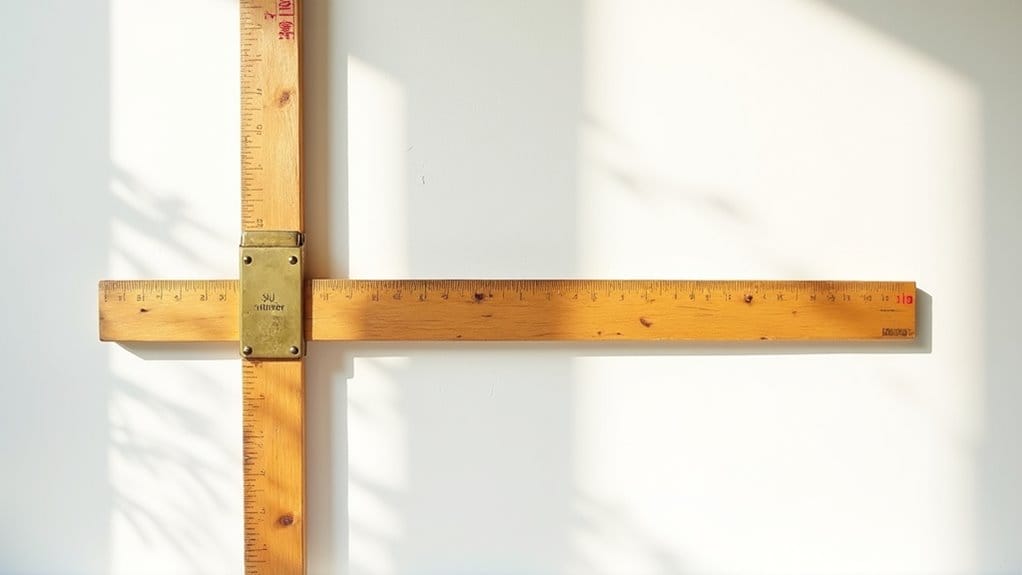
When you’re measuring vertical distances, you’ll find wooden folding rules offer distinct advantages over modern alternatives. These precision tools combine traditional craftsmanship with practical engineering to deliver exceptional accuracy in upright measurements. Their rigid segments maintain stability against gravity, while high-contrast markings guarantee clear readings at any height. Understanding the specific features that make wooden folding rules superior for vertical work will transform your measuring capabilities.
Key Takeaways
- The rigid hardwood construction prevents sagging during vertical measurements, ensuring accuracy and reliability compared to flexible tape measures.
- Segmented design allows convenient extension for tall measurements while maintaining compact storage when not in use.
- High-contrast, engraved markings resist fading and remain easily readable from various angles, even in poor lighting conditions.
- Articulated segments with locking joints enable precise measurements of both straight vertical distances and angles without distortion.
- Natural durability of hardwood materials like beech or boxwood provides long-term stability and resistance to warping.
Design Features of Wooden Folding Rules for Vertical Measurement

Your wooden folding rule’s segmented design allows you to extend it vertically for tall measurements while maintaining a compact form when folded for storage in your toolbox.
The hardwood construction guarantees the rule remains straight and stable during vertical measurements, preventing the sagging or flexing common in other measuring tools.
The bold, crisp graduations stamped into the wood’s surface provide excellent visibility from various angles, even in challenging lighting conditions or when you’re working on a ladder.
Foldable Structure for Extended Reach and Compact Storage
One of the most notable features of wooden folding rules is their foldable structure. This design allows the rule to extend to a considerable length when fully opened, enabling users to measure tall or hard-to-reach vertical surfaces accurately.
When not in use, the folding mechanism allows the rule to collapse into a compact size, making it easy to carry and store. This foldability balances the need for a long measuring tool with the convenience of portability, which is especially valuable on job sites or in tight workspaces.
Sturdy Wooden Material Providing Stability and Durability
The sturdy wooden construction of folding rules delivers essential stability for precise vertical measurements.
You’ll find that hardwood materials like beech or boxwood provide exceptional rigidity when extended, preventing the flex and sag common in metal tape measures. The wooden folding rule’s inherent stiffness allows you to maintain accuracy even when measuring overhead or at challenging angles.
The natural durability of quality hardwoods guarantees your measuring tool will withstand years of job site abuse.
Each wooden segment maintains its shape and resists warping, while brass joints and fittings protect against wear. This sturdy construction assures reliable measurements in demanding vertical applications.
Clear, High-Contrast Markings for Easy Reading at Different Angles
When measuring vertically, crisp black numerals and measurement marks stand out boldly against the light-colored wooden surface of quality folding rules.
You’ll find these high-contrast markings remain clearly visible even in challenging lighting conditions or when you’re working at awkward angles. The stark contrast guarantees accurate readings from various positions, reducing eye strain and measurement errors.
The carefully engraved markings won’t fade or wear off like printed measurements on metal tapes.
You can easily read the precise graduations while standing on ladders or scaffolding, as the markings are designed to be visible from multiple viewing angles, enhancing your measuring efficiency.
Functional Advantages in Measuring Vertical Distances

You’ll find that wooden folding rules excel at vertical measurements due to their lightweight yet rigid construction that minimizes sagging when extended upward.
Their precisely engineered locking joints prevent unwanted movement during use while ensuring accurate readings at various heights.
The rules’ articulated segments allow you to measure both straight vertical distances and angled measurements with equal precision, making them particularly effective for architectural and construction applications.
Lightweight Yet Rigid Design Minimizes Sagging
Durability meets precision in wooden folding rules designed for vertical measurements. When you’re measuring vertical distances, you’ll find that wooden folding rules remain remarkably stable due to their lightweight yet rigid construction.
The wood’s natural stiffness prevents the sagging that’s common with tape measures, especially when extended upward. The engineered hardwood sections maintain their shape while being light enough to handle easily.
You’ll notice the rule stays straight when measuring floor-to-ceiling heights or door frames. This rigidity guarantees accurate readings without the need for additional support, making wooden folding rules good for consistent vertical measurements in construction and carpentry work.
Locking Joints Ensure Accuracy and Prevent Unfolding Errors
Locking joints serve as the cornerstone of reliable vertical measurements with wooden folding rules. You’ll find these precision-engineered joints snap firmly into place at perfect 180-degree angles, eliminating wobble and drift during measurement.
The locking mechanism prevents accidental folding while you’re taking readings, ensuring your measurements remain accurate even when working at heights.
When extended, each joint’s brass fittings create a rigid connection that maintains proper alignment throughout the rule’s length. You can trust these locking points to hold steady as you measure floor-to-ceiling distances, doorways, or windows, delivering consistently precise results every time.
Versatility to Measure Various Heights and Angles
While traditional tape measures can be limiting, wooden folding rules excel at measuring varied vertical distances thanks to their rigid yet adjustable segments.
You’ll find folding rules are good for reaching high points while keeping segments locked at specific angles. When measuring vertical distances, you can extend the rule upward and maintain stability through strategic holding positions at joints.
The rigid sections let you measure overhead spaces and ceiling heights with better accuracy than flexible tape measures. You can also create right angles and other geometric configurations to measure around corners and across multiple planes simultaneously.
Comparison with Other Measuring Tools

When choosing between measuring tools, you’ll find that wooden folding rules offer rigidity and stability that tape measures can’t match, especially for extended horizontal measurements and architectural work.
While tape measures excel at flexibility and compact storage, wooden folding rules maintain their shape without sagging and provide clearer gradation marks that won’t wear off like printed measurements on tapes.
Digital measuring devices may offer precision and automated calculations, but they can’t match the reliability, durability, and battery-free operation of traditional wooden folding rules.
Wooden Folding Rules vs. Tape Measures
Although both wooden folding rules and tape measures serve essential measuring functions, they differ considerably in their applications and advantages.
Wooden folding rules are good for maintaining rigidity when measuring vertical surfaces, while measuring tapes tend to sag or bend. You’ll find that folding rules provide superior effectiveness when working with precise architectural measurements, especially in tight spaces where tape measures might collapse.
The rigid segments of folding rules also allow you to transfer measurements more accurately, particularly when working alone. For overhead measurements, the folding rule’s stability surpasses the flexibility of a tape measure.
Wooden Folding Rules vs. Digital Devices
Despite rapid technological advances in measuring tools, wooden folding rules maintain distinct advantages over their digital counterparts.
When you’re working in construction or carpentry, these traditional measuring tools prove more reliable and practical than complex electronic devices.
- You’ll never worry about dead batteries or malfunctioning screens in extreme temperatures.
- You can make quick marks and calculations directly on the wooden surface.
- Your folding rule won’t glitch or need recalibration like digital tools.
- You can easily measure vertical distances without the rule collapsing, unlike a tape measure.
These mechanical advantages make wooden folding rules consistently useful in professional settings.
Practical Tips for Accurate Use on Vertical Surfaces
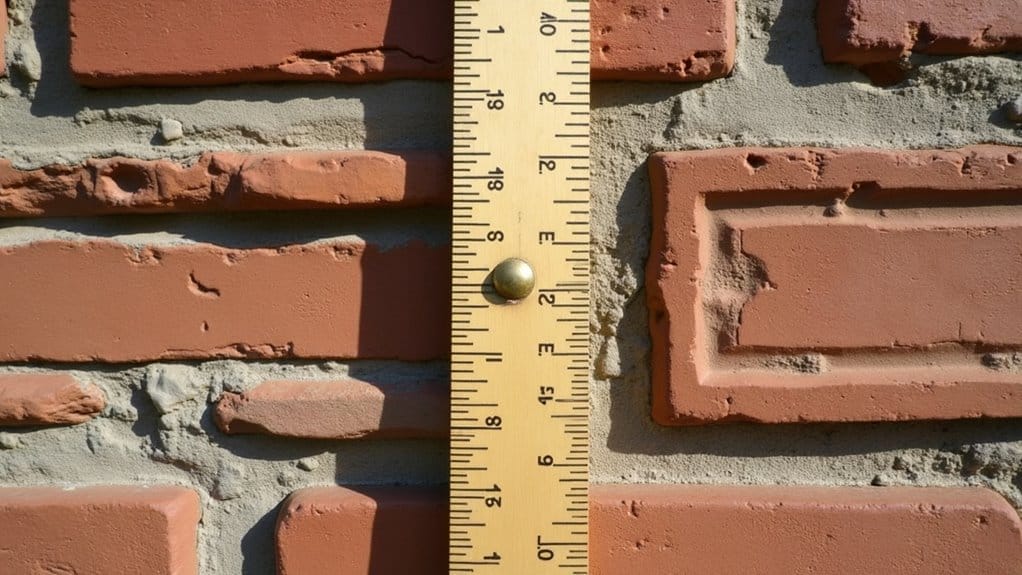
When measuring vertical surfaces with a wooden folding rule, you’ll need to press the rule flat against the wall while keeping it perfectly level using a small bubble level attachment.
You must guarantee each joint is fully locked and the rule’s segments are straight, as any slight bend will lead to inaccurate measurements.
Don’t rush to make marks – take time to verify the rule hasn’t shifted from its position and that you’re reading the measurements at eye level to avoid parallax errors.
Proper Techniques to Align and Stabilize the Rule
The proper alignment and stabilization of a wooden folding rule on vertical surfaces requires three fundamental techniques.
You’ll need to maintain consistent pressure while ensuring the rule remains square against the surface for accurate readings.
- Press the rule’s spine firmly against the vertical surface, using your thumb as an anchor point.
- Position your free hand at the rule’s bend points to prevent unwanted flex or movement.
- Keep your eye level parallel to the measurement point to avoid parallax errors.
- Lock each joint securely to maintain rigidity and prevent the rule from collapsing during use.
Common Mistakes to Avoid
Many woodworkers and craftspeople make critical errors when using folding rules on vertical surfaces, compromising their measurement accuracy.
Don’t rush to extend all sections at once, which can cause misalignment. You’ll get the best results by unfolding one section at a time while maintaining firm contact with the surface.
Avoid letting the rule cross or twist, as this distorts readings. Never substitute a tape measure when precision is critical – folding rules provide superior stability on vertical planes.
Keep your fingers away from joint mechanisms while extending sections to prevent sudden collapses that can throw off measurements.
Frequently Asked Questions
How Long Do Wooden Folding Rules Typically Last With Regular Use?
You’ll get 5-10 years from a quality wooden folding rule with proper care. Storage in dry conditions, regular cleaning, and avoiding excessive stress on joints maximizes its service life.
Can Wooden Folding Rules Be Repaired if Individual Sections Break?
You can repair broken wooden folding rules by replacing individual sections, reattaching hinges, or applying wood glue to splits. However, extensive damage may compromise the rule’s accuracy.
What Is the Best Way to Store Wooden Folding Rules?
Store your folding rule flat in a dry place, away from extreme temperatures and direct sunlight. You’ll want to keep it fully closed and lightly oiled to prevent warping and maintain joint flexibility.
Are Wooden Folding Rules Affected by Temperature and Humidity Changes?
Yes, your wooden folding rule will expand and contract with humidity and temperature changes. You’ll notice these fluctuations most when measuring in extreme conditions or storing the rule improperly.
Conclusion
You’ll find wooden folding rules superior for vertical measurements due to their inherent structural rigidity and segmented design. Their hardwood construction prevents sagging, while the high-contrast markings guarantee precise readings in various lighting conditions. When you’re measuring vertical distances, these tools offer unmatched stability and accuracy compared to flexible alternatives. For peak results, maintain your folding rule’s joints and store it flat between uses.