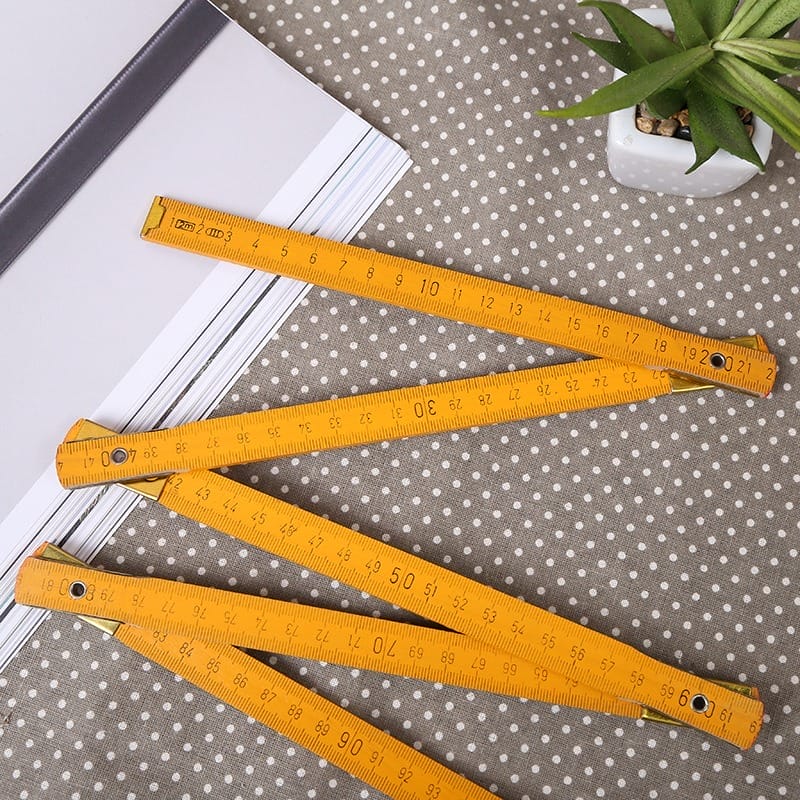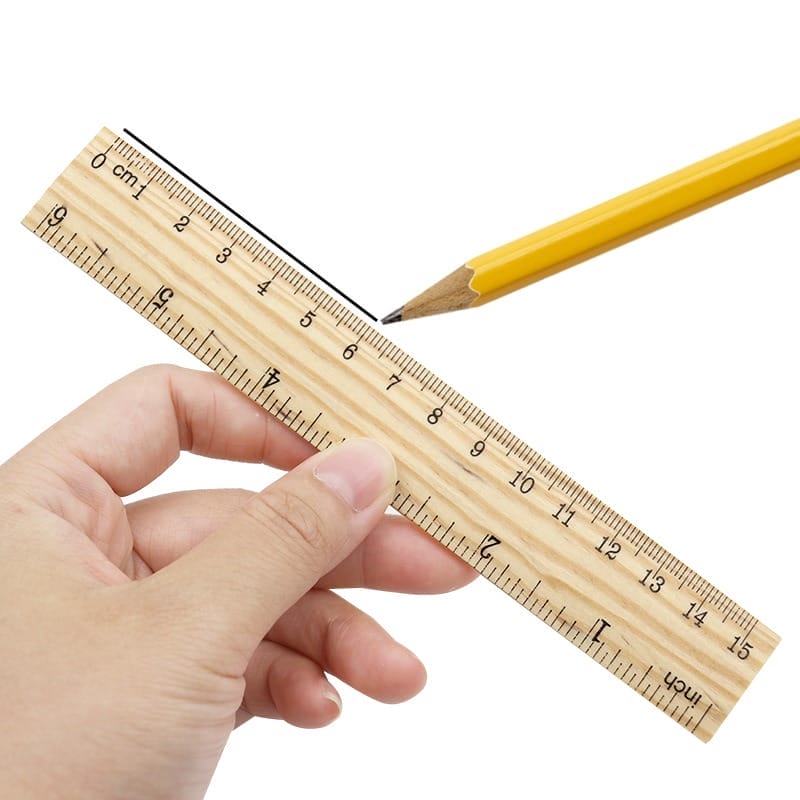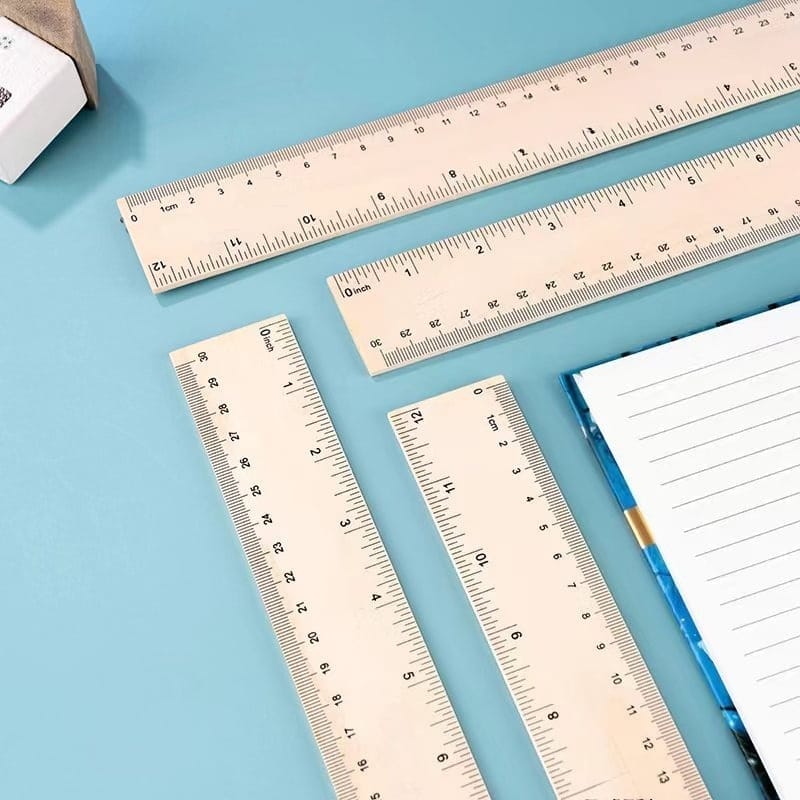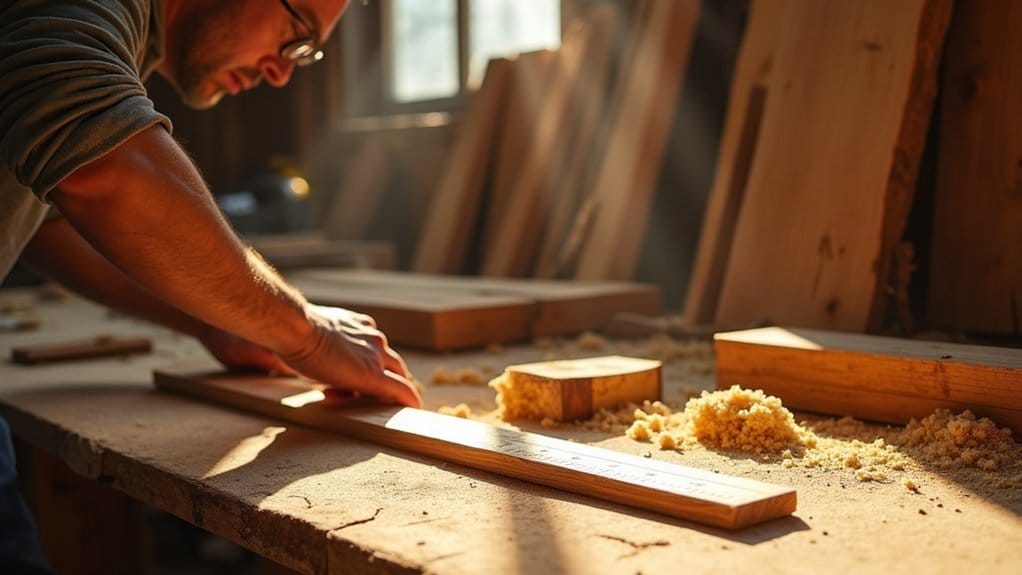
Let’s examine how wooden rulers, those precise measuring tools we’ve all used, come to life through a fascinating manufacturing journey. We’ll trace each step of their creation, from selecting premium hardwoods to the final quality inspections that guarantee accuracy. While they may seem simple at first glance, wooden rulers require careful engineering and multiple specialized processes that transform raw lumber into dependable measurement instruments.
Key Takeaways
- Hardwoods like maple and beech are cut into standardized blanks and kiln-dried to maintain 6-8% moisture content for stability.
- Industrial sanders smooth the wooden blanks’ edges and surfaces before measurement markings are applied through printing or engraving.
- Laser engraving creates precise measurement marks, with deeper etching for numbers and major lines to enhance readability.
- UV-resistant finish is applied to protect the wood and markings against moisture, wear, and sunlight damage.
- Quality control systems verify measurement accuracy to 0.1mm and inspect for printing defects before packaging in protective sleeves.
Design and Planning of Wooden Rulers

We’ll begin by examining how wooden rulers serve different measurement needs, from basic length measurements to specialized engineering and architectural applications.
To create precise ruler designs, we carefully analyze market requirements and client specifications, which determine factors like measurement units, subdivisions, and overall dimensions.
Our design process involves creating detailed technical blueprints that specify the exact placement of measurement marks, ensuring they’ll meet standardized accuracy requirements when transferred to the wooden blanks.
Understanding the Purpose and Types of Rulers
Before manufacturing wooden rulers begins, understanding their core purpose and various types is essential for proper design and planning.
Let’s examine the key elements that guide the development of these precision tools.
- Straight edge rulers serve as fundamental measuring devices, providing accurate measurements through clearly marked increments and standardized units.
- Specialty rulers incorporate additional features like metal edges, cork backing, or beveled surfaces for specific applications.
- Combination rulers integrate multiple measurement systems, such as metric and imperial units, enabling versatile use across different standards.
We’ll consider these variations carefully as we move forward in the manufacturing process, ensuring each ruler type meets its intended purpose and quality requirements.
Customizing Ruler Designs for Different Markets and Clients
The design phase of wooden ruler manufacturing begins with careful consideration of market-specific requirements and client preferences. We customize rulers based on regional measurement standards and intended uses while maintaining precision tolerances.
| Market | Customization Needs |
| Education | Simplified markings, larger numbers |
| Construction | Heavy-duty finish, wear resistance |
| Engineering | High precision graduations, size variety |
| Art/Design | Custom colors, specialty scales |
We adjust ruler size specifications from 6 inches to 36 inches, depending on market demands. Our design process incorporates specialized markings, measurement systems, and durability features to meet specific industry requirements while ensuring consistent quality across production runs.
Drawing Precise Measurement Marks on the Design Blueprint
Drawing precise measurement marks begins with creating detailed engineering blueprints in CAD software, which allows us to map out ruler graduations down to 1/64th of an inch accuracy.
We digitally draw and verify each measurement line’s positioning using vector-based tools for maximum precision.
We mark primary divisions first (inches, centimeters) as thicker lines with corresponding number values. Secondary divisions (1/2, 1/4, 1/8 inch) are drawn at specified shorter lengths. Tertiary marks (1/16, 1/32, 1/64 inch) are added as the finest graduations.
These digital specifications guarantee consistent accuracy when we transfer the design to production templates.
Material Selection and Preparation
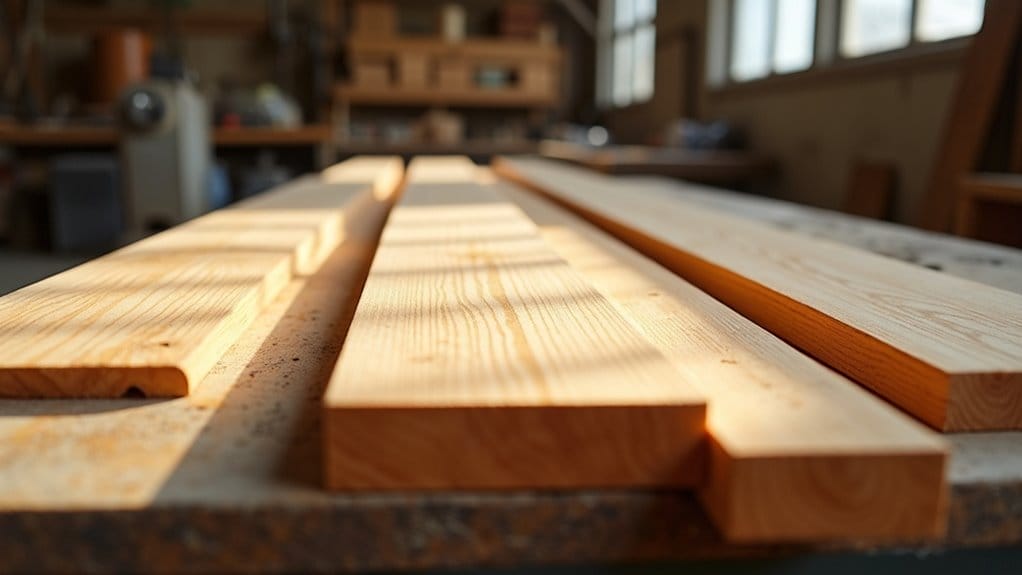
We’ll examine how our factory selects hardwoods like maple, beech, and basswood for their dimensional stability and resistance to warping – critical qualities for precise measurement tools.
The wood must meet specific moisture content requirements, typically 6-8%, which guarantees the ruler won’t expand or contract considerably with humidity changes.
After proper wood selection, the lumber is cut into standardized blanks matching common ruler lengths of 12, 6, or 36 inches, with extra allowance for final trimming and finishing.
Choosing the Right Wood for Durability and Accuracy
When manufacturing precision rulers, selecting the appropriate wood species serves as a critical first step that determines both durability and measuring accuracy.
We carefully evaluate each piece of wood to make certain it meets our strict quality standards.
- Hard maple and beech provide excellent dimensional stability and resist warping
- Quarter-sawn woods minimize expansion and contraction with humidity changes
- Fine-grained species allow for crisp, precise measurement markings
These characteristics guarantee our rulers maintain their accuracy over time.
We source only kiln-dried lumber with moisture content below 8% to prevent future distortion.
This careful wood selection forms the foundation for creating precise measuring instruments.
Cutting Wood to Standard Ruler Sizes
Once the properly seasoned wood arrives at our facility, our first manufacturing step involves cutting it into standardized blanks that will become rulers.
We use precision saws to cut the lumber into 12-inch lengths, maintaining strict tolerances of 1/32 of an inch. The blanks are then ripped to their final width of 1.25 inches before being planed to a uniform thickness of 3/16 inch.
Each cut must be perfectly square and smooth to guarantee accuracy in the finished product. We inspect every blank for defects before moving to the next production phase.
How Are Wooden Rulers Made: Manufacturing Process of Wooden Rulers

Let’s examine how our factory shapes raw wood into precise rulers using specialized cutting and planing equipment that creates the familiar rectangular form we all know.
After achieving the basic shape, industrial sanders smooth all edges and surfaces to guarantee safe handling and prevent splinters while maintaining strict dimensional tolerances.
We’ll see how automated printing systems or manual engraving tools precisely apply measurement markings using specialized inks or laser etching techniques that resist wear and maintain legibility throughout the ruler’s lifespan.
Shaping the Wood into Ruler Form Using Specialized Tools
After the initial wood selection and preparation, the manufacturing process moves to the specialized shaping phase where raw wooden blocks are transformed into recognizable ruler forms.
We utilize precision cutting tools and automated machinery to achieve the exact dimensions required for standard rulers.
- Industrial planers smooth the wood surface to a precise thickness while maintaining consistent density.
- Diamond-tipped cutting tools create perfectly straight edges and beveled corners along each line.
- Computer-controlled routers carve channels for metal edges and precise measurement markings.
Each piece moves through these shaping stations systematically, ensuring every ruler meets strict dimensional specifications before advancing to the marking phase.
Sanding and Smoothing Edges for User Comfort
The sanding and smoothing phase transforms the roughly shaped rulers into precision instruments with user-friendly edges.
We begin by feeding the rulers through automated belt sanders that use progressively finer grits to smooth the flat surfaces.
Next, we employ specialized edge-rounding equipment to soften all corners and sides, preventing splinters and ensuring comfortable handling.
Our final smoothing process involves a micro-finishing technique where the rulers pass through ultra-fine polishing drums. This step eliminates any remaining imperfections and creates the silky texture that’s essential for daily classroom and office use.
Quality control inspectors verify the smoothness by touch and sight before approval.
Applying Measurement Markings on the Ruler Surface
Once wooden rulers have been smoothed and prepared, measurement markings are precisely applied through an advanced laser engraving system.
The computer-guided lasers burn standardized measurements into the wood’s surface with pinpoint accuracy required for school and professional use. Metric measurements are engraved on one side, while imperial units are marked on the opposite edge.
Each increment gets laser-etched at specific depths to guarantee lasting visibility and durability.
Numbers and major measurement lines are burned deeper than minor marking lines for better readability.
This automated process guarantees consistent marking placement and spacing across thousands of rulers daily.
Techniques to Draw Clear, Long-lasting Measurement Lines
While laser engraving provides precise measurements, we employ additional techniques to guarantee the ruler’s markings remain clear and durable throughout years of use.
We begin by sealing the wood with a protective coating that prevents moisture absorption. Next, we design measurement lines using specialized equipment that maintains consistent line weight and spacing.
We apply fade-resistant paint to fill the engraved markings, ensuring they stand out against the wood grain. Finally, we coat the ruler with a clear UV-resistant finish that protects both the wood and markings from wear, sunlight damage, and repeated handling.
Quality Control and Customization

We’ll examine how each ruler undergoes rigorous quality control checks to verify the precise placement and accuracy of measurement marks against calibrated standards.
Through specialized optical scanning equipment, we test for consistency in graduations and guarantee there are no printing defects or misalignments that could compromise measurement accuracy.
We can customize rulers to meet specific client requirements, including unique measurement scales, corporate branding, or specialized marking intervals for educational or technical applications.
Inspecting Accuracy of Measurement Marks
Testing stations along the production line verify the accuracy of each ruler’s measurement marks through a multi-step inspection process.
Our quality control team guarantees every ruler meets strict measurement standards that make it easy for students to take precise readings.
- Digital scanners compare markings against calibrated reference standards
- UV light inspection detects any printing defects or misalignments
- Automated measurement systems verify spacing between graduations to 0.1mm accuracy
We check each ruler against certified measurement standards before packaging.
This rigorous process helps maintain consistency across production batches and guarantees measurement accuracy that meets international calibration requirements.
Customizing Rulers According to Client Specifications
Building on our strict measurement standards, our production line adapts to meet diverse client requirements for customized wooden rulers.
We modify our base designs to incorporate specific length measurements, custom gradations, and specialized scales based on project needs. Our advanced printing systems allow us to add client logos, unique color schemes, and branded elements while maintaining measurement accuracy.
We can adjust ruler thickness, width, and material grade to match intended applications.
Whether clients need metric, imperial, or hybrid measurement systems, we configure our production parameters to deliver precise customization while ensuring each ruler meets our rigorous quality benchmarks.
Packaging and Shipping the Final Product

We carefully wrap our finished wooden rulers in protective sleeves or boxes to prevent scratches and damage during transit, often using bubble wrap or corrugated cardboard for additional protection.
Our packaging line organizes rulers into standardized quantities like dozens or gross units, which we then place into larger shipping cartons with appropriate cushioning materials.
We’ve optimized our logistics system to handle both small retail orders and large bulk shipments efficiently, using tracking systems and appropriate carriers based on destination and volume.
Protecting Wooden Rulers During Packaging
Carefully packaging wooden rulers requires multiple protective layers to prevent damage during transit.
We create protective barriers using:
- Acid-free tissue paper wrapping around individual rulers to prevent scratches
- Long cardboard sleeves or tubes that house groups of 10-12 rulers securely
- Bubble wrap or foam padding between layers for shock absorption
We place these wrapped bundles into sturdy corrugated boxes with additional cushioning materials in any void spaces.
This systematic approach guarantees our wooden rulers arrive at their destination without warping, splintering, or surface damage.
The multi-layer protection maintains product quality through various shipping conditions and handling methods.
Efficient Logistics for Bulk Project Orders
Managing bulk orders requires precise coordination of our logistics pipeline to efficiently handle large volumes of wooden rulers.
We consolidate orders into standardized shipping units of 12 gross per carton, optimizing both storage space and transport costs. Our automated tracking system monitors 7 key delivery benchmarks, from warehouse picking to final destination arrival.
We utilize cross-docking methods for urgent bulk orders, minimizing warehouse dwell time.
For school district orders exceeding 1,000 units, we implement zone-based distribution strategies, coordinating directly with receiving departments to guarantee seamless delivery across multiple locations.
Frequently Asked Questions
Why Do Some Wooden Rulers Have a Metal Strip on One Edge?
We add metal edges to wooden rulers to prevent wear and tear from repeated use against other tools, ensuring measurements stay accurate and protecting the ruler’s graduated markings.
Can Wooden Rulers Be Recycled With Regular Wood Waste?
We can’t recycle wooden rulers with regular wood waste since they contain non-wood elements like metal strips, printed markings, and finishes. They’ll need specialized disposal through electronic waste facilities.
How Long Does a Typical Wooden Ruler Last With Regular Use?
We’ve found that wooden rulers typically last 3-5 years with regular classroom or office use, though their lifespan depends on storage conditions, handling frequency, and environmental exposure.
Are Wooden Rulers More Environmentally Friendly Than Plastic Ones?
We find wooden rulers more eco-friendly since they’re biodegradable and made from renewable resources, while plastic rulers create persistent waste and depend on petroleum-based materials during manufacturing.
Why Do Some Wooden Rulers Feel Smoother Than Others?
We’ll find smoother rulers are made with finer-grit sandpaper during production, plus multiple sanding passes and protective finishes like lacquer or varnish that fill wood’s natural pores and grooves.
Conclusion
We’ve detailed the systematic process of wooden ruler production, from careful hardwood selection through precision manufacturing steps. Our examination has shown how quality control measures and specialized tools guarantee dimensional accuracy and durability. We’ve demonstrated that successful ruler manufacturing depends on controlled drying, precise cutting, and laser-engraved measurements. Through these standardized processes, we’re delivering consistently reliable measurement tools.