Have perfect round frames ever felt just out of reach, no matter how carefully you measure and cut? Do projects that should be simple fall apart when you try to figure out how to make a wooden circle frame with clean edges and tight joints?
Many woodworkers assume a professional round frame demands a lathe, CNC router, or industrial machinery. That myth stops a lot of great projects before they start. In reality, you can cut a precise circular frame in a small shop with common woodworking tools, a simple jig, and solid planning.
Now you will learn two proven construction methods, how to choose the one that fits your shop, what tools and materials you really need, and the exact routing, joinery, and finishing steps that give a frame a professional look.
Key Takeaways
- Two reliable build paths: The glued-up panel method favors beginners because the joinery is simple and the router does most of the precision work. The segmented ring method suits experienced woodworkers who want maximum lumber efficiency, creative grain patterns, and are comfortable with careful angle work.
- Router and circle jig as the core tools: A router paired with a circle-cutting jig sits at the center of this project for most shops. Good lumber, strong wood glue, clamps, and basic sanding gear form the rest of the core tool set.
- Rabbet turns a ring into a frame: A proper rabbet around the inner opening turns a wooden ring into a real frame that can hold glass, artwork, and backing.
- Reinforcement where it counts: Mechanical reinforcement such as biscuits or domino-style loose tenons adds strength where long seams meet, especially in segmented frames or large heavy mirrors.
- Pre-cut components to save time: Pre-cut, laser-cut wooden circles from QlycheeCrafts remove the hardest cutting steps for many woodworkers. These disks give you consistent sizes from 10 mm to 300 mm, clean edges that need very little sanding, and a fast path to both small DIY projects and higher-volume frame production.
Understanding The Two Primary Construction Methods For Circular Frames

Before picking up a tool, you need to decide how you will build the frame body itself. That choice sets the tone for the whole project, from lumber needs and time on the saw to how much sanding you do at the end. Both of the main paths can lead to a round, accurate frame, but they differ a lot in wood waste, difficulty, and design options.
The Glued-Up Panel Method Simplicity And Continuous Grain
The glued-up panel method builds a single wide blank by edge-gluing boards, then cutting the circular frame out of that blank with a router and a circle jig. You turn several straight pieces of lumber into one solid panel first, then treat that panel as if it were a large, thick sheet of plywood made from real boards.
This method shines because the joinery is simple and easy to repeat. There are no tricky compound angles and no need to calculate exact segment lengths. You focus on straight cuts, good glue coverage, clamp pressure, and then accurate router setup for the inner and outer circles. For someone learning how to make a wooden circle frame for the first time, that simplicity takes away a lot of stress.
The trade-off is wood waste and lumber size. To cut a circle from a rectangle, you sacrifice the four outside corners and the inner circle cutout. Those offcuts can feed smaller DIY projects, coasters, or wood plaques , but they still represent extra material. You also need wider lumber, or more boards glued together, as the frame diameter grows. Despite that, this method is a top choice for small and medium frames and for anyone without a finely tuned table saw.
The Segmented Ring Method Precision And Efficiency
The segmented ring method builds the frame as a loop of identical wedge-shaped pieces. Each segment has angled ends that meet its neighbors, forming a polygon (an octagon, dodecagon, and so on). Once the glue dries, you treat that polygon as a blank and remove the corners to form a perfect circle.
This approach is strong when you care about wood efficiency and visual design. Because you cut segments close to their final shape, wasted material is far lower than with a big panel. You also gain full control over grain direction and color. You can:
- Rotate the grain to point toward the center for a starburst effect.
- Let the grain sweep around the circle for a flowing look.
- Mix species for stripes and repeating patterns that no store-bought frame will match.
Segmented construction rewards accuracy and patience. Every segment needs the same length and end angle, or the ring will either leave gaps or refuse to close. A high-quality table saw, a stable cross-cut sled, and a precise angle setting become very important here. Small angle errors repeat at every joint around the circle and add up, so this method is better for woodworkers who already feel comfortable with careful layout, angle setting, and test fitting.
Essential Tools And Materials For Professional-Quality Circle Frames

No matter which method you choose, the quality of your tools and materials shows up in the finished frame. A clean circle cut, tight seam, and smooth finish all rely on the right gear, set up correctly before the first board touches a blade. Tool needs shift a little between glued-up panels and segmented rings, but there is a big shared core.
Lumber, Panels, And Adhesives
The wood you choose affects both appearance and workability. Many woodworkers start with pine 2×6 boards because they are affordable, easy to cut, and available at most home centers. Pine is a good choice when you first learn how to make a wooden circle frame, especially in smaller sizes. For frames that need more impact or toughness, hardwoods such as oak, maple, or walnut give a firmer surface and deeper grain.
Board width ties directly to your chosen method. With a panel build, you may need wider lumber or more boards edge-glued together for large diameters, because the panel must be bigger than the outside of the round frame in both directions. A segmented ring gives more freedom, because each segment comes from a narrower strip, so you do not need wide lumber for big circles.
Strong, fresh wood glue holds everything together. A quality yellow or cross-linking PVA glue rated for woodworking gives long-lasting bonds that can exceed the strength of the wood itself.
Essential Power Tools and Equipments
Below is a simple summary of what counts as core gear and what counts as helpful extras.
| Tool or Item | Primary Role | Essential or Optional |
|---|---|---|
| Router with circle-cutting jig | Cuts inner and outer circles, often rabbet | Essential |
| Miter saw or table saw | Prepares boards and segments | Essential |
| Clamps (panel and strap types) | Holds panels and rings during glue-up | Essential |
| Orbital or palm sander | Smooths faces and edges | Essential |
| Bandsaw or jigsaw | Roughs out outer shape before routing | Optional |
| Biscuit or domino-style joiner | Reinforces seams and improves alignment | Optional |
| Disk sander | Speeds up curve shaping on outer edge | Optional |
Method 1 – Crafting A Circle Frame From A Solid Glued-Up Panel

The glued-up panel method is the most direct way for many woodworkers to learn how to make a wooden circle frame. You turn straight boards into a wide blank, then let the router and circle jig create the inner opening, rabbet, and outer profile. The work feels similar to building a tabletop at first, then shifts into more precise routing as you near the final shape. Understanding wood grain patterns explained can significantly enhance the aesthetic appeal of your projects. By recognizing the unique characteristics of different types of wood, you can make more informed choices that complement the overall design. This knowledge not only improves the visual impact but also aids in selecting the appropriate finishing techniques for each type of grain.
Step 1: Preparing And Gluing Your Wood Blank
Start with a clear idea of your finished frame size. Add several inches to the planned outer diameter in both directions to give room for the circle jig and any small layout errors. From that size, decide how many boards you need to glue together to reach the required width and cut them all to the same length on a miter saw.
Next, think about grain direction and movement. Lay the boards on a flat surface and flip every other one so the growth rings on the end grain alternate up and down. This simple trick helps reduce cupping over time. Then adjust the order and orientation of the boards until the face grain seems to flow around the center of the panel.
Glue application matters more than a fancy clamp rack. Spread a thin, even film of wood glue along each joint edge, covering the full length without big dry spots or thick ridges. Bring the boards together and apply clamps across the panel, spacing them so pressure spreads from end to end. Tighten just enough to create a small, consistent bead of squeeze-out along every seam.
Let the glue cure fully, often overnight. When you remove the clamps, scrape off any dried wood glue before it hardens like stone. Check the panel for flatness. If there is a slight crown or twist, correct it with a hand plane, drum sander, or a simple router sled before you move on. The flatter this blank is now, the easier every later circle cut will be.
Step 2: Setting Up Your Router Circle-Cutting Jig
Place the cured panel on a sacrificial surface such as foam insulation or scrap plywood. Secure it so it cannot slide or spin.
Find the true center of the panel. The usual method is to draw two diagonal lines from corner to corner and mark where they cross. Drill a small pilot hole at that point, just large enough for the pin or screw on your circle jig. If you want to avoid any mark on the frame itself, screw a small square of scrap wood over that center and place the pivot in the scrap instead.
Before setting any radius, measure the piece you are inserting. That might be a mirror, round artwork, or even a clock movement. Note that finished diameter and decide how much overlap you want from the frame:
- Inner radius = half the artwork diameter minus the planned overlap.
- Outer radius = half the artwork diameter plus the planned frame width.
For example, if your artwork is 10 inches across and you want the frame to cover a quarter inch of the edge and also be 1 inch wide, your inner radius lands at 4.5 inches and the outer radius at 6 inches.
Mount the circle jig to your router, then slide the router along the jig arm until the bit sits at the right distance from the pivot pin for the inner circle. Lock that setting carefully. With the jig attached and the pivot in place, you can cut the opening exactly where you want it.
Step 3: Routing The Frame In Proper Sequence
Order of operations matters in this method. Work from the inside out so the bulk of the panel supports the router until the last cut. This means you start with the inner circle, then cut the rabbet, and only then free the frame with the outer circle cut.
For the inner circle, set the depth of cut to a shallow setting, often around one quarter of an inch or less. Install an up-cut spiral or straight bit, place the router on the panel with the jig pin in the center, and start the router away from the wood. Once it reaches full speed, ease the bit into the surface and walk the router around the circle. After one trip, lower the bit a little and repeat. When you have the inner circle routed all the way through the panel, you can remove the inner waste piece.
Now it is time to cut the rabbet that will support the artwork stack. If you use a rabbeting bit, install it, set the depth slightly deeper than the combined thickness of your glass, artwork, and backing, and run the bearing against the fresh inner circle edge. That single move will cut the rabbet at a consistent width. If you use a straight bit instead, reset the circle jig for a slightly larger radius so the bit rides at the outer edge of the rabbet. Make repeated passes to the planned depth, then remove the thin ring of waste between this cut and the inner opening.
The final step is the outer circle. Adjust the jig to the outer radius you calculated earlier. Once again, use several shallow passes rather than one aggressive move. You can cut close to the layout line first with a jigsaw if the panel is thick and you want to spare your router. As the last pass breaks through the back, the frame separates from the outside waste. Support it so it does not fall or chip at the exit point.
Method 2 – Building A Segmented Circle Frame For Maximum Efficiency

Segmented construction trades simple glue lines for efficiency and design control. Instead of cutting a circle out of a big rectangle, you create a ring from many angled pieces, then round the outside and inside. If you want to know how to make a wooden circle frame with minimal waste and dramatic grain patterns, this is the method to study. For those looking to enhance their crafting projects, wholesale wooden circles for crafts can be an ideal choice. They offer a versatile base for various applications, from home decor to custom art pieces. With high-quality materials available at wholesale prices, you can experiment with different sizes and finishes to suit your creative vision.
Step 1: Mathematical Planning And Precision Segment Cutting
Start with clear target sizes. Decide on the final outer diameter, inner diameter, and frame width or thickness before you touch the saw fence. These numbers will guide every later angle and length choice.
Next, choose how many segments you want in the ring. Eight segments give a fast build and a bold pattern in the grain, but leave more material to remove when you round the ring. Twelve segments strike a nice balance, since the polygon already looks close to a circle. Sixteen or more segments give an almost round blank from the start but bring more joints to cut and glue.
Angles come from simple math:
- Divide 360 degrees by the number of segments to find the angle around the circle for each one.
- Divide that result by two to find the miter angle to cut on each end of a segment.
Segment length depends on the target diameters. You can use trigonometry or a reliable online segment calculator to find the inner and outer edge lengths based on your circle size and segment count. Once you have those numbers, turn to your table saw.
Cut one end of a board at the chosen angle, set a stop block on your sled fence to control overall segment length, and then work down the board cutting segment after segment. This stop block helps every piece match in length. Even a half-degree angle error or a small length difference repeats at each joint and can keep the ring from closing, so this is a place to move slowly and double-check your settings.
Step 2: Assembly Techniques For Gap-Free Segmented Rings
Before reaching for glue, arrange all of your segments into a rough ring on a flat surface. Push the ends together and see what the gaps tell you. A thin, consistent gap at every joint suggests that the angle is slightly off and needs adjustment. If the ring refuses to close, your segments are too long. If it overlaps, they came out too short.
Once the dry fit looks solid, spread a thin layer of glue on both mating faces of each joint. Assemble the ring again on a flat board. Wrap a variable angle strap clamp around the outside of the ring, snug the strap, and then tighten gradually. Watch the top face as you go and tap segments down so they all sit flat on the board, without twist or rocking. Light brad nails near the outer edge can help prevent pieces from shifting while the strap pulls tight, though they are optional.
Let the ring cure fully under pressure. Excess glue that squeezes into the inside curve should be scraped off once it gels but before it hardens. When the glue dries, you will have a many-sided polygon with solid joints and a shape ready for final refinement into a circle.
Step 3: Shaping The Polygon Into A Perfect Circle
Start by flattening both faces of the ring. Run it through a drum sander, use a router sled, or take careful strokes with a hand plane across the joints. A flat ring sits safer on any jig or lathe and also looks more professional in the final frame.
The most accurate way to create the inner and outer curves is to reuse the router and circle jig method from the panel approach. Attach the ring to a sacrificial backer board with screws near the outer edge or with strong double-sided tape. Find and mark the center of the ring. Place the jig’s pivot at that point, set the radius for the inner opening, and take multiple shallow passes until the inner circle cut drops out. Then reset the radius for the outer edge and repeat the sequence until the outside corners are gone and you hold a perfectly round frame.
Creating The Rabbet – The Professional Detail That Holds Your Artwork

No matter how precise your circle, a frame without a rabbet is just a ring. The rabbet provides the ledge that supports glass, artwork, and backing so they sit flush and secure. If this step goes wrong, the piece you are inserting may rattle, tilt, or even fall through the front opening.
Understanding Rabbet Purpose And Dimensions
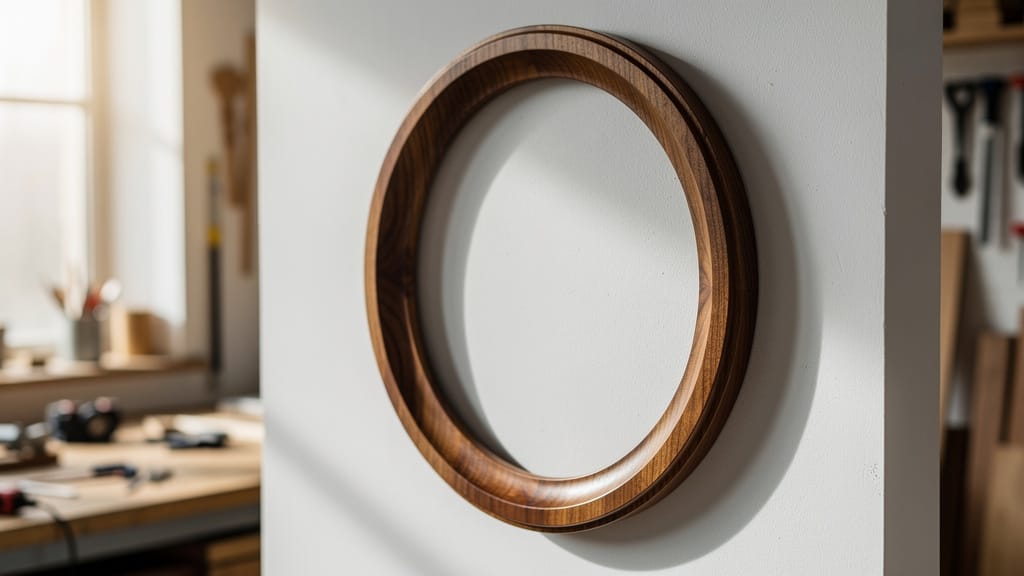
A rabbet in a circular frame is an L-shaped recess cut into the inner back edge. Seen in cross-section, it looks like a shelf that runs all the way around the inside of the frame. That shelf holds glass or plexiglass, the artwork or mirror, and a backer board, and keeps them from slipping forward.
Depth comes first. Add the thickness of every layer in your stack, then add a small amount of extra space for easy fit, often about one sixteenth of an inch. For many projects, that total lands between one quarter and three eighths of an inch. Width comes next and sets how far the frame overlaps the artwork face. Many woodworkers aim for a quarter to three eighths of an inch of overlap so the frame grips the edge without hiding too much of the picture.
A shallow rabbet leaves parts of the stack sticking out of the back of the frame, which looks unfinished and can scrape the wall. A very deep rabbet cuts too far into the frame and weakens the cross-section. Careful measuring before you start any cut keeps the frame strong and the artwork safe.
Cutting Techniques For Different Construction Methods
With a glued-up panel frame, the best time to cut the rabbet is after the inner circle is done but before the outer circle frees the frame from the blank. In that stage, the workpiece is still a full panel with plenty of support under the router, and the inner circle edge gives a perfect guide.
If you have a rabbeting bit, this step becomes very straightforward. Install the bit, set the depth to the number you worked out from your artwork stack, and run the router around the inside of the circle. The bearing on the bit follows the inner circle as a guide, so the rabbet keeps a constant width. One or two slow passes usually bring the depth to the mark without burning the wood.
On a segmented ring frame, the sequence changes slightly. Shape the polygon into a circle first, then cut the rabbet. Clamp the round frame to your bench with the back facing up. Run a handheld router with a rabbeting bit around the inner back edge, letting the bearing trace the curve. For shops that use a lathe, the rabbet can be cut on the lathe itself with a parting tool or scraper while the frame spins.
In every case, test the rabbet with the actual glass, artwork, and backing before you move on to finish. It is much easier to deepen the recess or widen it slightly now than to try to fix a tight fit after stain and varnish go on.
The Finishing Process – From Raw Wood To Polished Masterpiece

Treat finishing as its own stage of how to make a wooden circle frame rather than an afterthought. The process follows a clear pattern. First, you get the shape right. Then you move through a sensible grit sequence. Finally, you apply a finish that suits the frame’s location and style.
Progressive Sanding For Flawless Surface Preparation
Move into a grit progression that removes scratches in stages:
- 120 grit: Erase tool marks, dried glue remnants, and any coarse scratches.
- 150–180 grit: Remove the marks left by 120 grit and start to make the surface feel smoother.
- 220 grit: Refine the surface to a level that takes stain or clear finish well without visible sanding lines.
- (Optional) 320 grit by hand: For very smooth, natural oil finishes, especially on the front face.
At each stage, sand with the grain on flat faces to hide scratch direction and use smooth motions on curves. Break all sharp edges before moving to finish.
Choosing And Applying Your Finish
Clean wood and clean air matter as much as the product you choose. Inspect the frame in bright light from several angles to catch leftover scratches or dust. Any particles that stay on the surface at this stage will show up later as bumps in the finish.
Common choices for circle frames include:
- Penetrating oil finishes (such as tung oil or Danish oil) that soak into the fibers of the wood and highlight grain without building a thick film on top. You usually flood the surface with oil using a rag, let it sit for a short time, then wipe away the excess. These finishes are easy to refresh later if the frame gets scratched and work well in low-risk locations.
- Film-forming finishes (such as polyurethane, varnish, or lacquer) that build a protective layer on the surface. Thin coats work better than thick ones. You can brush on oil-based or water-based polyurethane, sanding lightly with very fine paper between coats to give the next layer a good surface to bond to. Lacquer often sprays on and dries fast, which helps when you want several coats in one day.
- Paint for solid color work, especially when you build from budget lumber or want a bold tone to match decor. Apply a primer that suits your paint type, let it dry, then sand lightly to knock down raised grain. Follow with multiple thin coats of paint rather than one thick coat, sanding very lightly between coats if the surface feels rough.
Whatever finish you choose, read the label for drying times, recoat windows, and safety steps. Work in a clean, ventilated space. Let the final coat cure fully before installing glass and artwork so the frame does not trap solvent fumes inside.
Using Pre-Cut Components For Efficiency And Consistency
For many woodworkers, the hardest part of how to make a wooden circle frame is not the rabbet or the finish but the perfect outer circle cut. Routing a wide, heavy panel in a big arc or rounding a segmented polygon takes time, skill, and confidence with power tools. Pre-cut components can take that stress off the table without turning the project into a paint-by-number kit. One way to simplify this task is to explore various techniques for bending wood easily. These methods not only enhance the flexibility of your materials but also allow for more creative designs. As you gain confidence using these bending techniques, you’ll find new opportunities to experiment with shapes in your woodworking projects.
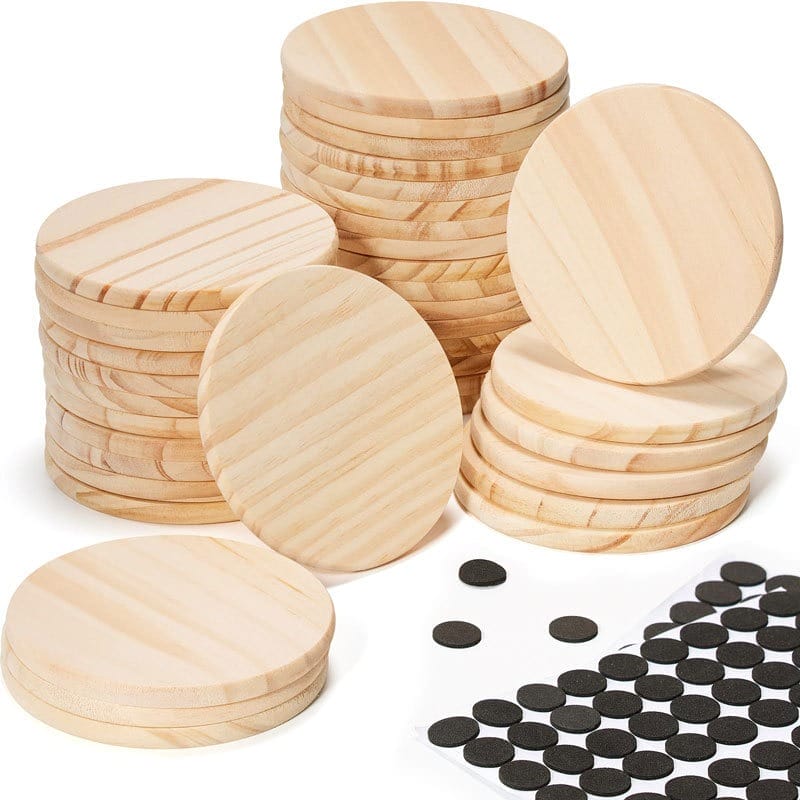
QlycheeCrafts specializes in laser-cut wooden circles made from high-grade poplar plywood. Sizes range from tiny 10 mm pieces up to 300 mm disks and can be ordered in bulk or as custom runs. The laser process creates edges that are clean and very close to final size, which often need only a light sanding. Because the cutting is automated and carefully checked, each circle from a batch matches the rest, which matters if you plan to sell sets of frames or build a series of similar projects.
These circles can play several roles in a frame project:
- For smaller items, a single wood slices can serve as the front ring after you cut an inner opening and rabbet with a router, just as you would in the glued-up panel method.
- For thicker frames, you can glue two identical circles together with a spacer ring between them, then sand and finish the outside, which again avoids the need to cut a large outer circle from raw lumber.
- For production work, consistent disks help you standardize sizes and streamline your workflow.
Using pre-cut circles is not a shortcut that cheapens the project. It is simply another way to control one stage of the build. You still decide how to make a wooden circle frame feel special through your choice of rabbet depth, joinery, visible grain, and finish.
Conclusion
A round frame might look simple on the wall, but by now you have seen how many choices hide behind that clean outline. You can learn how to make a wooden circle frame from a glued-up panel or from carefully cut segments, and each route offers its own mix of simplicity, efficiency, and design freedom. Once the frame body is set, the rabbet, reinforcement, and finish bring it to professional level.
If you prefer to skip the most demanding circle cuts or need consistent parts for a growing side business, QlycheeCrafts pre-cut wooden circles offer a smart base for your work. Combine those precision components with the routing, joinery, and finishing methods in this guide, and you can produce round frames that look refined, hold their contents securely, and stand out from mass-produced options.
FAQs
Can I make a wooden circle frame without a router?
It is possible, but the process takes more sanding and patience. You can lay out inner and outer circles on a panel or segmented ring, then cut close to the lines with a jigsaw or bandsaw. After that, you refine the curves with rasps, files, and sanders until the frame looks smooth and round. This works well for rustic or painted projects, but it is harder to keep the opening perfectly round than when you use a router and circle jig.
What thickness should I use for a round wooden frame?
For most wall frames that hold art or a mirror, a thickness around three quarters of an inch gives a good balance of strength and weight. Thicker stock around one inch can look more substantial on large diameter frames or mirrors. Very thin frames under half an inch may warp more easily and leave less space to cut a safe rabbet. Always match thickness to the size of the piece you are inserting and to the style you want on the wall.
How do I hide seams in a glued-up circle frame?
Seams start to disappear when you plan for them during panel glue-up. Arrange boards so the grain flows in a gentle curve around the center instead of in straight stripes, and alternate growth rings to control movement. After you complete the inner circle cut and outer circle cut, sand all edges evenly so there are no steps or ridges at the glue lines. A stain that is not too light, followed by a clear wood finishing, often helps seams blend into the overall pattern. If you want to avoid seams entirely on smaller frames, you can also start from a single pre-cut circle from QlycheeCrafts and focus your effort on the inner circle and rabbet instead of the panel.